What to fix first in energy data governance
First published on: 11/11/2026
By Stewart Wallace, Director of Data Design & Governance at Zema Global
Energy and commodities firms do not need to fix every data problem at once to achieve data maturity. They should begin with the data that supports high-value operational decisions, establish clear ownership, make sources and transformations traceable, standardize business definitions, monitor critical quality issues, and control how data is changed. This creates a trusted foundation without turning governance into a multi-year clean-up program.
Start where poor data can change a commercial, risk or operational outcome — for example, an incorrect valuation price, a stale curve, inconsistent units or an undocumented manual adjustment.
Why do energy and commodities firms struggle with data governance?
Energy and commodity operations combine time-sensitive information from internal systems, vendors, exchanges, counterparties and operational assets. It often passes through spreadsheets, integration layers, trading platforms, risk models and reporting tools before reaching a decision-maker.
The difficulty is not simply volume. The same value may appear in several systems, use different names, arrive on different schedules or change without a complete record. Across North American operations, firms may also need to reconcile power markets, pipeline locations, hubs, time zones, units and settlement conventions.
The result is a familiar set of data management pain points:
-
Teams cannot agree which source is authoritative.
-
Data issues are discovered late, often during reporting or reconciliation.
-
Business definitions differ across desks, functions or regions.
-
Manual corrections are difficult to trace.
-
Ownership is unclear when something goes wrong.
-
Critical processes depend on a few experienced employees.
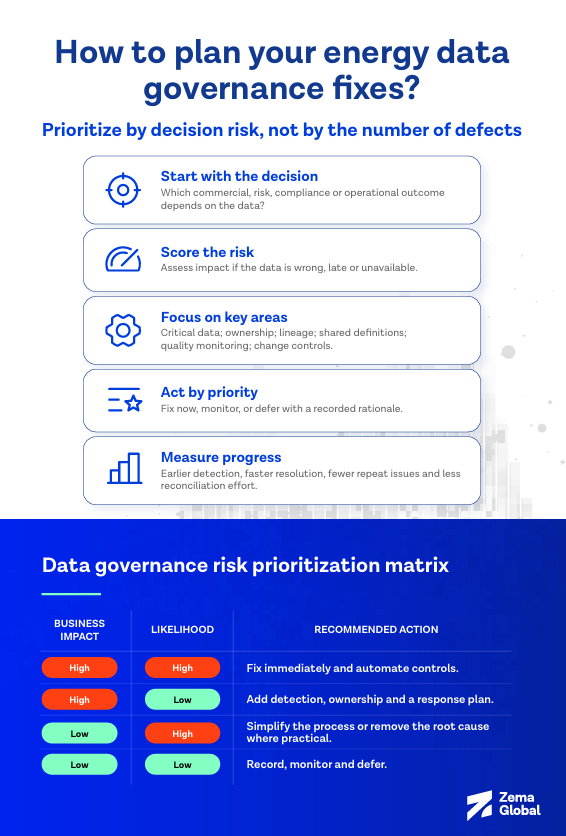
Trying to solve these issues enterprise-wide can create a large program with limited operational impact. Prioritize according to decision risk instead.
These same challenges can also hold back AI initiatives. When data sources are unreliable, definitions are inconsistent or governance controls are unclear, AI can amplify existing problems rather than deliver better insights. A trusted data foundation is just as important for AI readiness as it is for everyday business decisions.
What should you fix first in data governance and quality?
Strengthen data governance and quality by focusing on these key areas:
1. Start with decision-critical data
Do not begin with a complete inventory of every field in the organization. Begin with one important business outcome and trace the data required to produce it.
Good candidates include daily valuation, forward-curve construction, exposure reporting, position reconciliation, settlement, scheduling, regulatory reporting or an operational planning workflow. Ask three questions:
-
Which decisions depend on this output?
-
What would happen if the data were wrong, late or unavailable?
-
Which inputs have the greatest influence on the result?
This produces a manageable set of critical data elements and connects governance to business value.
Fix first: inputs that can materially affect profit and loss, risk limits, compliance, customer commitments or physical operations.
Fix later: low-use data with no clear connection to an important decision, obligation or control.
2. Give every critical data product an accountable owner
One of the most common data governance challenges is confusing technical custody with business accountability. IT may operate the systems, but it should not be expected to decide whether a price, curve, hierarchy or calculation is fit for a commercial purpose.
Each critical data product needs a business owner accountable for fitness for use, a steward responsible for definitions and rules, a technical owner responsible for delivery, and named consumers who can explain the decisions it supports. Document critical rules and exception-handling procedures so teams are not dependent on individual employees' knowledge.
Ownership should include clear response expectations. If a critical value fails a quality check, who investigates it, approves any substitute and informs downstream users? Governance becomes operational only when those answers are unambiguous.
An executive sponsor should provide oversight, while a designated governance forum should have the authority to resolve disputes over ownership, definitions and priorities.
3. Make sources and transformations traceable
Before writing dozens of new policies, establish where critical data comes from, which source is authoritative and what happens to it. A practical lineage record should identify the original source, ingestion route, transformations, manual interventions, calculation logic and downstream destinations.
Where multiple sources provide conflicting values, the accountable business owner should determine which takes precedence and document any exceptions.
This does not require perfect enterprise-wide lineage on day one. Start with the selected workflow and focus on where values are mapped, combined, converted, enriched or overridden.
Traceability reduces the time spent asking “Where did this number come from?” When a symbol changes, a source arrives late or a calculation is updated, teams can see which reports, models and decisions may be affected.
The same principles should apply when onboarding new data feeds, integrating systems or incorporating data from acquisitions. Establishing ownership, authoritative sources and quality requirements from the outset helps prevent new data issues from entering critical workflows.
4. Standardize the definitions that cause repeated friction
Do not attempt to build a universal business glossary before fixing the terms that repeatedly cause errors. Start with concepts used across multiple teams or systems: location names, instrument identifiers, units of measure, currencies, time zones, calendars, counterparties, portfolios and curve definitions.
For each term, document the agreed meaning, format, owner, approved synonyms and relevant systems. This matters when a firm grows through acquisition or across regions, where simple terms may carry different meanings.
5. Monitor the quality dimensions that matter to the decision
Data quality management should not become a contest to create the most rules. Select controls based on how the data is used.
For energy and commodity workflows, the most useful dimensions often include:
-
Timeliness: Did the data arrive when the decision required it?
-
Completeness: Are expected intervals, locations, contracts or attributes present?
-
Validity: Does the value conform to an expected format, range or business rule?
-
Consistency: Do units, currencies, time zones and identifiers align across systems?
-
Accuracy: Does the value reflect the source or real-world event it represents?
-
Uniqueness: Are duplicate records creating double counting or conflicting results?
Set thresholds according to business impact. A missing field in an archived record does not deserve the same response as a stale price entering a current valuation. The aim is to detect material defects before they affect decisions.
For organizations managing large volumes of market data, automated monitoring can help put these principles into practice. Solutions such as Zema Sentinel help identify late, missing or incomplete data, giving teams earlier visibility into potential issues before they affect downstream workflows.
Every alert should therefore have context: severity, affected process, owner, required response time and acceptable remediation.
6. Control data adjustments and overrides
Manual and automated adjustments are not automatically governance failures; in fast-moving markets, they can provide necessary flexibility. The risk arises when changes are invisible, unapproved or impossible to reproduce.
Prioritize controls for manual, automated and AI-driven adjustments to critical data. Record who or what changed the value, when it changed, the previous and new values, the reason, the approval status or governing authorization, and the processes affected. Where temporary substitutions are used, define when they expire and how the authoritative value will be restored.
With these priorities established, the next step is to plan which issues to address first, based on their impact on business decisions.
What should a 90-day data governance plan include?
A focused 90-day plan should prove that governance can improve a real operational outcome.
Days 1–30: Select and map. Choose one decision-critical workflow. Identify its consumers, critical data, sources, transformations, owners and known failure points. Establish a baseline for issue volume and investigation time.
Days 31–60: Control and monitor. Agree shared definitions, quality rules, and thresholds. Introduce ownership, escalation, and auditability for manual changes. Give business and technical teams a shared view of issues.
Days 61–90: Improve and scale. Remove the highest-impact root causes, measure the change and document the operating model. Then select the next workflow using the same risk-based method.
Apply the same governance requirements to new data feeds and system changes to prevent recurring issues.
Measure progress through both data quality and business outcomes, such as fewer valuation adjustments, reduced reconciliation effort, more reliable reporting and fewer disruptions to critical operations.
How do you know what not to fix yet?
Defer an issue when the data has no identified consumer, no material impact, very low use or a remediation cost that clearly exceeds its business value. Record the decision and revisit it if the use case changes.
This applies governance in proportion to risk, directing attention to the data that matters instead of treating every defect as equally urgent.
Build trust one decision at a time
Effective data governance and quality programs do not begin with a policy library. They begin by making an important decision more reliable.
The clearest path is to focus on the data issues that matter most to business decisions, demonstrate measurable improvements in one critical workflow, and progressively extend that approach across trading, risk, operations and reporting.
Zema Global's Decisioning Infrastructure provides a governed source of truth across complex energy and commodities data workflows, giving organizations greater visibility, control and confidence in the data behind critical business decisions — so teams can spend less time investigating data and more time acting on it.
Ready to identify the data issues worth fixing first? Talk to Zema Global about building a practical path to trusted operational data.
Frequently Asked Questions
What is data governance in energy and commodities?
Data governance is the ownership, definitions, controls and decision rights used to ensure data is suitable for operational, commercial, risk and reporting purposes.
What is the difference between data governance and data quality management?
Data governance defines who is accountable, which standards apply and how decisions are made. Data quality management measures, monitors and improves whether data meets those standards. Governance provides direction; quality management provides evidence and action.
Which data quality issue should an energy firm fix first?
Fix the issue most likely to affect a material business decision or obligation. Typical priorities include stale or missing prices, inconsistent units, broken mappings, duplicate records, unexplained data adjustments and data that cannot be traced to an authoritative source.
Does data governance require an enterprise-wide program?
No. Start with one high-value workflow, establish ownership and controls, demonstrate improvement and then scale the approach.