Small signals, big consequences: The cost of slow detection in data operations
First published on: 11/17/2026
By Daniel Bains, Director of Product Management at Zema Global
A hairline crack in the pipeline
In physical infrastructure, the most dangerous failures rarely start dramatically. They start as a hairline crack: easy to overlook, easy to dismiss, and increasingly expensive the longer it goes unnoticed.
Data operations work the same way. A commodity data provider corrects a historical value. A feed quietly stops updating. A dataset goes stale. A scheduled process fails, or a dependency changes without warning. On its own, each looks like a small technical issue.
But in energy and commodity environments, data doesn't sit still. It flows into curves, valuations, risk models, trading positions, and regulatory reports. A small signal that isn't caught, or isn't understood, can travel a long way before anyone realizes what it touched. Which raises the question this article is really about: is the real cost of a data issue the failure itself, or the time it takes to understand it?
What does a data incident really cost?
The technical event is usually the easy part. Modern monitoring will tell you if a data feed is late or if a job has failed. The hard part is everything that comes after:
-
What data has actually been affected?
-
Which downstream processes depend on it?
-
Who is using the impacted information right now?
-
Are other events connected to this one?
-
Could it affect pricing, valuation, trading, risk or reporting?
-
What is the potential financial impact?
-
Where should the team start investigating?
When answering those questions means hopping between logs, monitoring tools, data platforms and subject-matter experts, every incident generates a large volume of invisible work. It doesn't appear on a dashboard. It rarely gets measured. But it consumes hours of skilled time, pulls people away from higher-value work and delays the decisions that actually limit damage.
And the clock matters. The longer it takes to understand an issue, the further it can travel, and the more likely a small signal becomes a larger business problem.
So here's a question worth putting to your team: when you last had a data incident, how much time went into fixing it, and how much went into working out what it had affected?
The ripple effect: how a small issue becomes financial exposure
One failed feed can look isolated. But if that feed supports valuation, risk, analytics or trading workflows, its real impact is measured by how far it travels. The escalation tends to follow a familiar path:
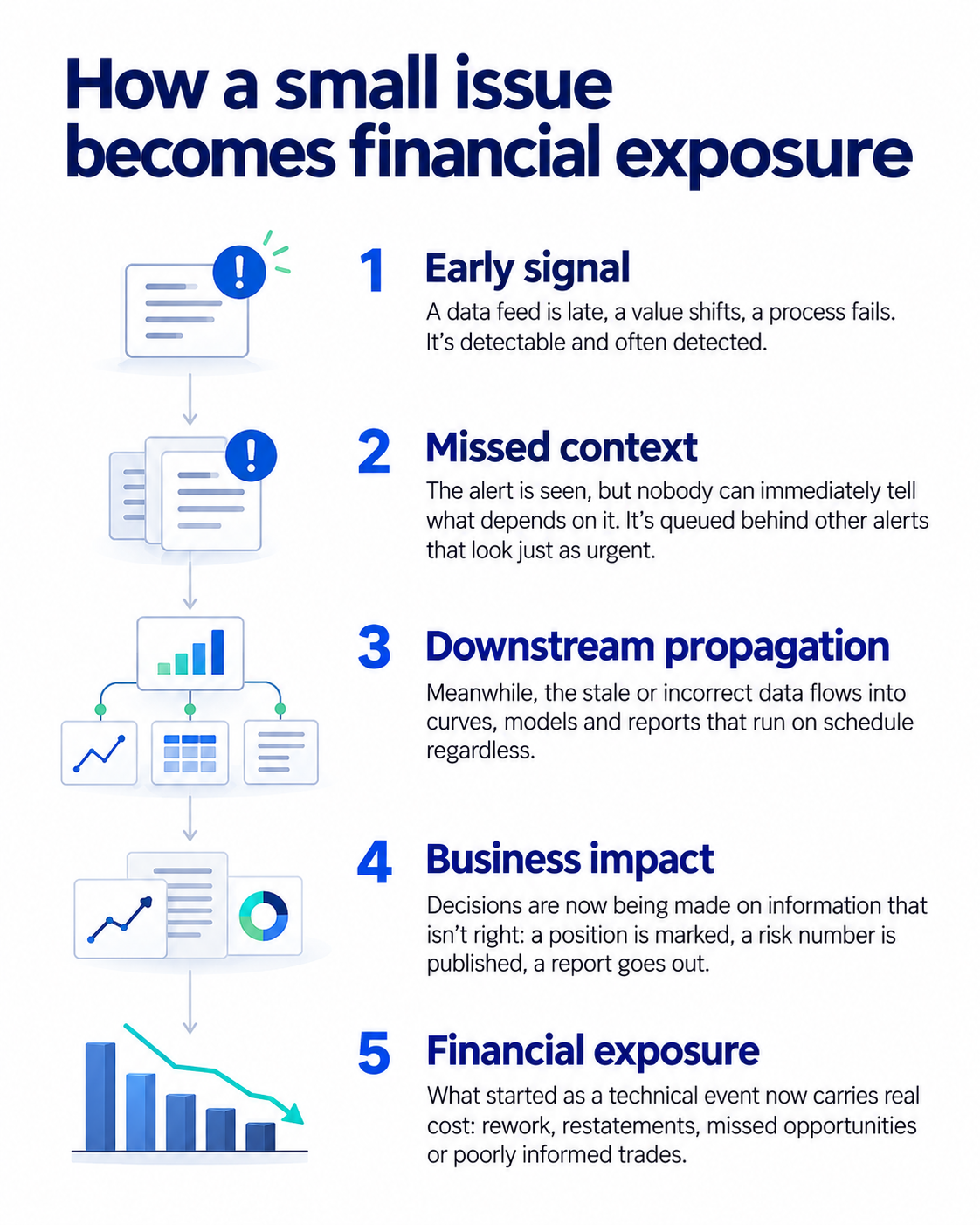
That gap is exactly where observability ends and operational intelligence needs to begin. Notice where things go wrong. It's rarely at step one. Most organizations are good at spotting the signal. The damage happens in the gap between step one and step two, when the signal exists but its meaning doesn't.
What does it take to turn operational signals into intelligence?
Closing the gap between detection and understanding isn't a single feature. It takes several capabilities working together, in sequence: Connect → Normalize → Contextualize → Detect → Correlate → Prioritize → Explain.
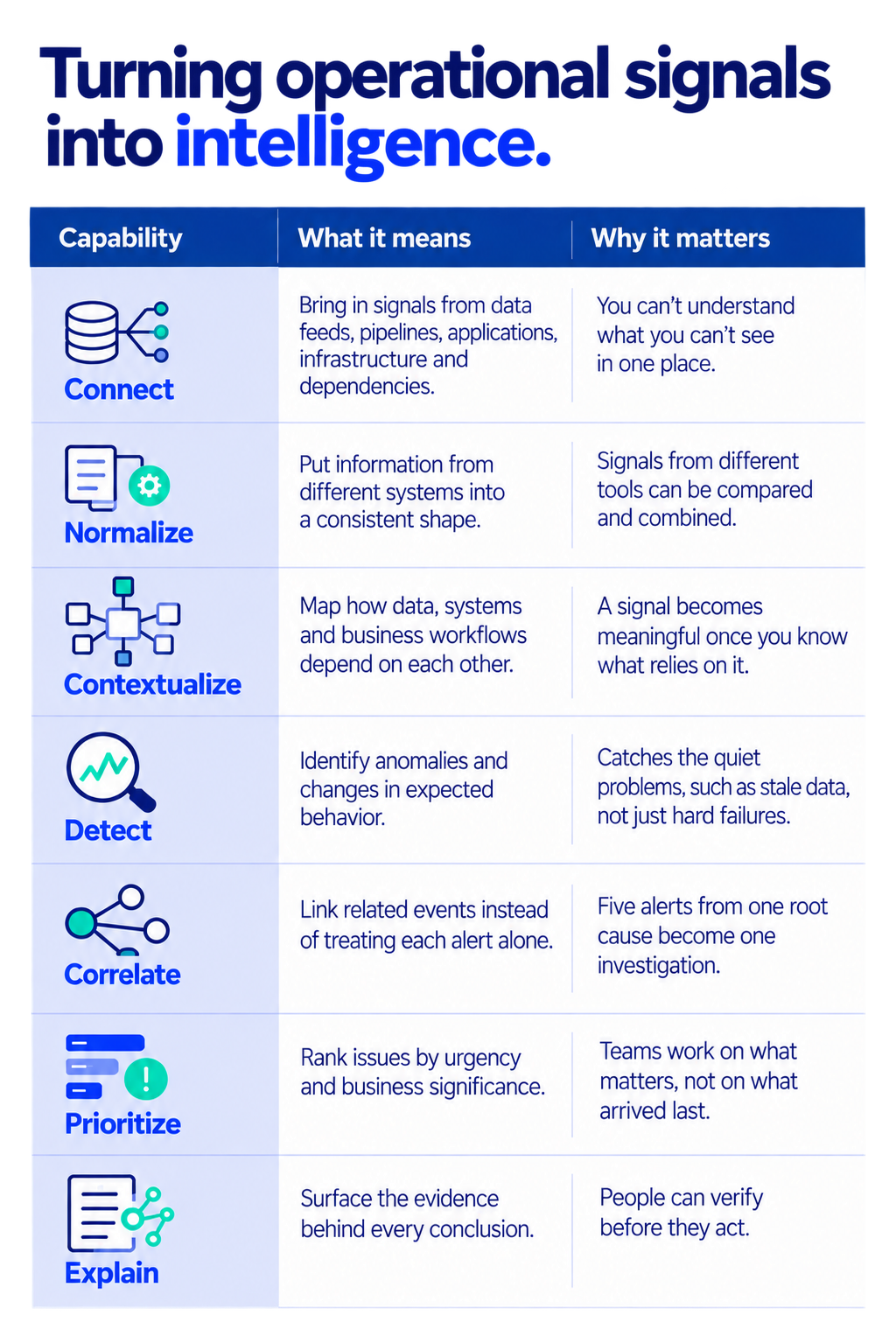
Cost operational stacks cover two or three of these well. The value comes from all of them working as one system, so that a signal arrives already connected to the data and workflows it supports.
A useful exercise: map your current tooling against these capabilities. Where you find a gap, you'll usually find a person filling it by hand.
Where does AI add value to incident investigation?
Once operational information carries context, AI can add a genuinely useful layer on top. It can help:
-
Summarize an incident in plain language.
-
Identify relationships between events that a person might miss.
-
Explain the likely downstream impact.
-
Surface the supporting evidence behind its conclusions.
-
Guide users step by step through an investigation.
The key word is once. Without context, AI just produces a more articulate version of the same alert. With context, it becomes part of a broader decisioning intelligence capability that helps teams grasp the significance of a signal before its impact spreads.
The goal was never more alerts. It's fewer surprises.
Why does operational intelligence need to be explainable?
In critical energy and commodity workflows, an insight is only as good as the confidence people have in it. When a recommendation could influence a valuation, a risk limit or a trade, "the system says so" isn't enough.
Operational intelligence needs to be traceable and explainable. Users should be able to see what was detected, how events were connected, why an issue was prioritized and what evidence supports that view. That transparency is what lets teams act quickly and responsibly, and it's what makes AI-assisted decisions defensible to risk, compliance and leadership.
How big is your detection-to-decision gap?
Try answering these honestly for your own environment:
-
If a source corrected a historical value overnight, how quickly would you know which curves, models and reports used the old number?
-
Could you list every downstream process that depends on your most critical feed, without asking anyone?
-
When three alerts fire at once, can your tools tell you whether they share a root cause?
-
Do you know the potential financial exposure of an incident while it's happening, or only afterwards?
-
Could you show an auditor the evidence trail behind your last prioritization decision?
Every "not really" is a place where a small signal has room to become a big consequence.
How Zema Sentinel closes the gap
Zema Sentinel brings these capabilities together around the complex data environments Zema Global customers run every day. It connects operational signals to the data and business workflows they support, so teams can see not just that something has happened, but what it affects and why it matters.
By bringing monitoring, data lineage and dependencies into a single operational view, Zema Sentinel helps teams trace where issues originate, understand their downstream impact and identify where to focus their efforts. AI-powered insights help detect emerging risks earlier, while agentic root-cause analysis supports faster investigation and recommends corrective actions. For routine issues, self-healing capabilities can also resolve problems automatically, under governed controls and with human oversight where it matters.
The result is a shorter distance between three moments that are often hours apart today: identifying an operational issue, understanding its business and financial impact, and deciding on the right response. It also means less time spent manually investigating and resolving incidents, and greater confidence in the data and processes behind critical business decisions.
The bottom line
The real challenge isn't detecting that something happened. It's recognizing the signal early enough, understanding its context quickly enough, and acting before a small operational issue becomes a larger business and financial problem.
Your monitoring can already see the crack. The question is whether you can see where it leads.