Backtesting and backcasting: validation approaches for stronger analytics
First published on: 17/7/2026
Author: Brock Mosovsky, SVP of Commercial Analytics at Zema Global
Robust risk oversight demands two distinct but complementary capabilities: backtesting, which evaluates how well your models would have predicted the future from a historical vantage point, and backcasting, which replays actual single-path market outcomes to validate portfolio behavior and operational performance. Zema Global’s cQuant Analytics delivers both as built-in capabilities, with workflow controls and model configuration tools that make these exercises straightforward, repeatable, and audit-friendly.
How backtesting works
Backtesting in cQuant Analytics recreates the analytics you would have run on a specific historical date, then compares those forecasts with what happened. To run a back test you pick a historical date and restrict the platform’s visibility to only the market data and events that would have been available on or before that date.
cQuant Analytics then:
-
Parameterizes all simulation models using only the historical information available as of the back test date, including forward curve history, volatilities, correlations, spot-price histories, hourly/daily shapes, and other inputs.
-
Performs portfolio valuations and stochastic risk simulations against that restricted dataset.
-
Produces forward-looking confidence bands and risk metrics that can be compared to realized prices and valuations over the subsequent historical window.
The platform’s filters make it easy to restrict input series — forward curves, spot histories, volatility surfaces, correlation matrices, and other relevant market data — to the pre-cutoff period. That means you’re testing the model against the exact information an analyst would have seen and used in the past. This gives you a true out-of-sample view of model performance.
Backtesting is central to model governance. When realized outcomes systematically fall outside modeled confidence bands, that signals the need to recalibrate. For example, modeled volatilities may need to be increased so simulated risk bands better reflect observed market behavior. We’ve seen this in practice: one Zema Global customer performed a back test around Winter Storm Fern, a late January 2026 event associated with extremely high gas and power prices and over 1 million power outages in the Eastern U.S., and found that realized portfolio outcomes during that extreme event fell between the P95 and P99 of cQuant Analytics’ pre-event forecasts. This validated that the customer’s volatility inputs and the platform’s Net Position at Risk (NPaR) approach were producing conservative, credible risk assessments that encompassed the possibility of extreme events to occur.
What backcasting is — and why it matters
Backcasting is a deterministic exercise: instead of simulating many possible futures, you evaluate the portfolio against the single, realized path of market variables for a user-specified historical period. That deterministic real-world replay supports model validation, operational review, and performance analyses across a range of use cases:
-
Configuration and logic validation. A deterministic backcast quickly reveals whether assets, contract logic, dispatch rules, and settlement mechanics are implemented correctly by comparing modeled cash flows and dispatch decisions against observed outcomes.
-
Operational KPIs and “percent-of-perfect.” For dispatchable assets (batteries, thermal plants, storage), backcasting lets you compute realized performance versus a perfect-foresight benchmark. Teams can use this “percent of perfect” view to quantify lost value from forecasting or operational friction and track improvements over time.
-
Root-cause and attribution analysis. When outcomes diverge from expectations, a deterministic replay makes it easier to trace whether the gap came from market moves, model assumptions, or asset behavior.
-
Auditability and governance. Deterministic backcasts provide an auditable, reproducible record of how the portfolio would have been valued and operated under actual market conditions — critical for internal reviews, governance process, and regulatory evidence.
-
Stress and hybrid analyses. Because cQuant Analytics allows deterministic backcasts to be combined with stochastic forecasts in the same run, you can replay realized paths for the recent past while simulating alternate futures beyond that window. This creates a practical way to examine tail exposures that are anchored in observed market behavior.
Below is an example visualization that illustrates exactly this hybrid approach: a deterministic backcast period followed by a forward-looking stochastic forecast. The chart shows monthly gross margin (a heat-rate call option valuation) with deterministic realized values in the backcast window and stochastic confidence bands for the forecast horizon.
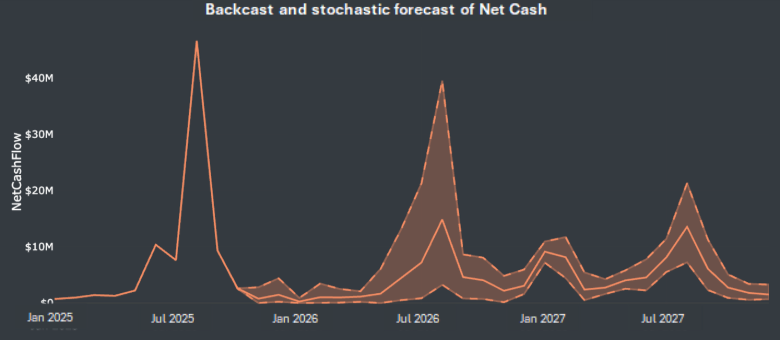
Figure: Monthly Gross Margin: backcast (Jan 2025–Oct 2025) and stochastic forecast (Nov 2025–Dec 2027).
This figure captures a deterministic backcast from January 2025 through October 2025 (realized monthly valuations) followed by a stochastic forecast from November 2025 through December 2027 (simulated confidence bands). The analysis is the valuation of a heat rate call option (HRCO) that settles against ERCOT North Hub Real-Time Power Prices and Houston Ship Channel (HSC) natural gas prices. The solid line denotes the realized/backcast valuation and the expected value of the contract within the forecast period; the shaded/dashed area depicts forward-looking simulated risk bands used for probabilistic risk assessment.
How the two approaches work together: seamless combination and practical benefits
cQuant Analytics enables teams to mix deterministic and stochastic approaches: set an analysis start date inside a historical window and a forward-looking simulation will naturally combine the realized path up to that date with stochastic forecasts thereafter. This hybrid capability is useful for scenario construction, conditional stress tests, and analyses that address both a factual historical baseline and probabilistic forward uncertainty.
Together, backtesting and backcasting give risk managers and modelers a complete toolkit for calibration, validation, and continuous improvement. Backtesting ensures your stochastic framework and volatility assumptions are calibrated to how markets actually behave; backcasting ties the analytics to operational reality and provides clear, auditable KPIs for dispatchable resources and contractual behavior.
Get started
If you’d like to see how backtesting and backcasting can support your model governance, operational KPIs, or regulatory reporting, we’d be happy to walk through examples using your portfolio and historical periods of interest. Contact the Zema Global team to schedule a demo or to discuss how these capabilities can be embedded into your risk management workflow.