A mild winter is not necessarily a low-risk winter
First published on: 11/18/2026
By Pierre Lebon, Director of Analytics EMEA at Zema Global
How weather, interconnection, and portfolio position shape risk in European power markets
A mild winter does not automatically mean a low-risk winter for European power markets. Seasonal temperatures describe an average, and they do not show whether cold spells will coincide with low wind generation, higher electricity demand, expensive gas, or constrained cross-border flows.
For utilities, independent power producers, energy retailers, and trading teams, the financial outcome depends on how those conditions interact with each portfolio’s physical assets, contracts, procurement obligations, and hedges.
That distinction changes the question market participants need to ask. The issue is not simply whether Europe will experience a mild or severe winter. It is which combinations of weather and market conditions could occur within the season, how they could spread across interconnected markets, and where the resulting exposure would appear in the portfolio.
What can the winter outlook tell us?
Current seasonal forecasts favor a relatively mild European winter, although they cannot rule out shorter periods of colder or more disruptive weather.
The Copernicus Climate Change Service currently favors above-average seasonal temperatures across much of Europe during winter 2026–27. It also indicates that atmospheric circulation may change as the winter progresses, potentially increasing the influence of higher pressure in polar regions.
This is a probabilistic seasonal outlook, not a forecast for individual cold spells, low-wind periods, or stressed market hours. A warmer-than-average season can still contain conditions that matter commercially.
The U.K. Met Office has also challenged recent media claims that El Niño or changes in the polar vortex mean a severe U.K. winter is imminent. Its assessment suggests that El Niño may increase the likelihood of milder, wetter conditions early in winter, while changes in the stratospheric polar vortex could increase the potential for cold spells later in the season. Neither mechanism provides a precise forecast for the U.K. or Europe.
The important point is not that the favored seasonal outlook is wrong. It is that average temperature alone cannot describe European power market risk.
Why can a mild winter still create power market risk?
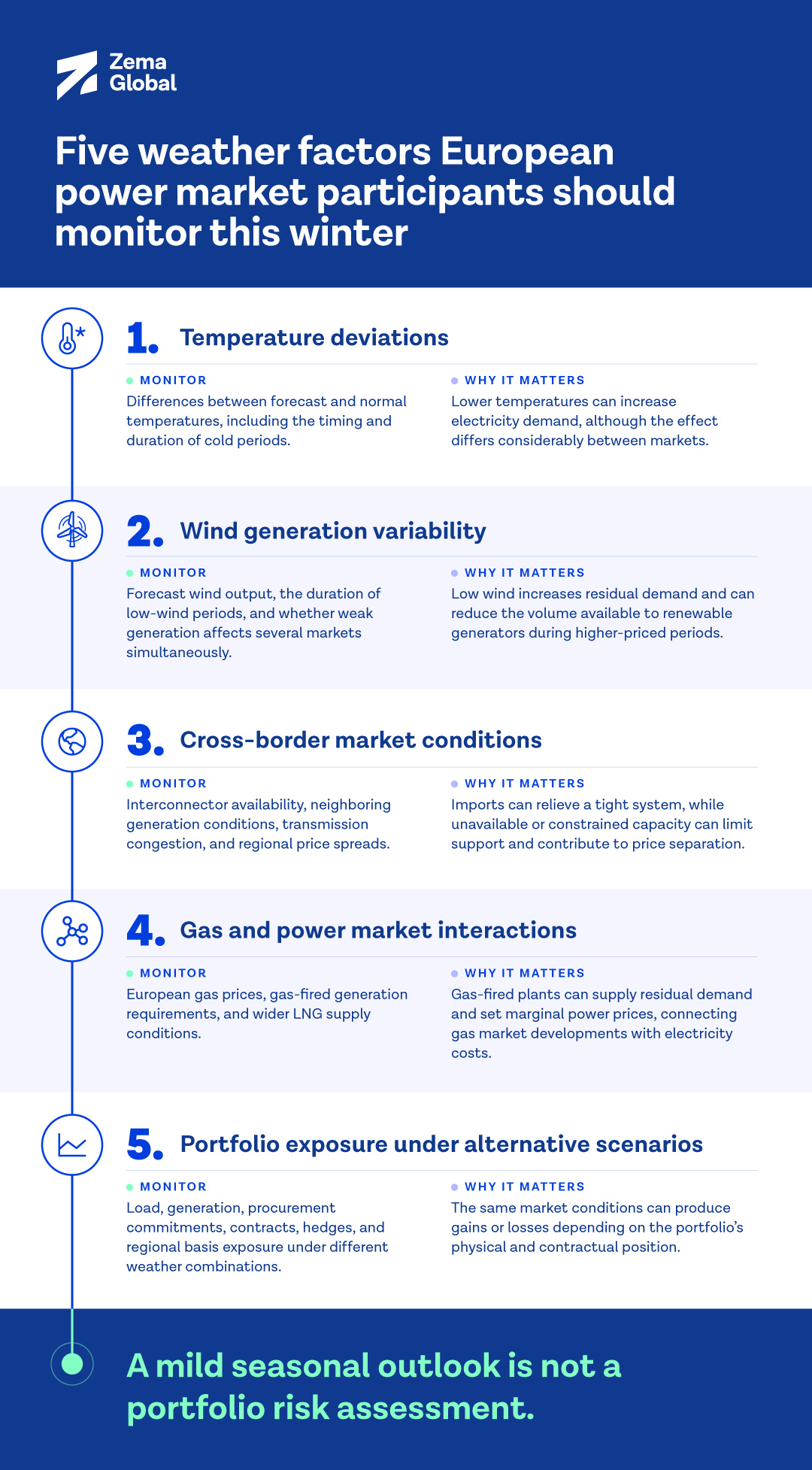
Temperature, wind generation, fuel costs, plant availability, and electricity demand do not move as a single system. The more significant market outcomes tend to emerge when several of these factors align unfavorably.
Temperature sensitivity also differs between countries. France is particularly responsive because of the role of electric heating. France’s transmission system operator, Réseau de Transport d’Électricité (RTE), estimates that a 1°C decline in winter temperature can add approximately 2.4 gigawatts (GW) of electricity demand.
The relationship is not directly transferable to every European market. Heating technologies, building efficiency, industrial demand, and consumer behavior all influence how temperature affects load. This is one reason a pan-European seasonal forecast cannot be translated into a uniform demand outcome.
Wind creates a separate source of uncertainty. Mild conditions do not guarantee strong wind generation, just as colder conditions do not always coincide with low wind. The more difficult periods arise when weak renewable output increases residual demand while consumption or other supply constraints are already tightening the system.
The European Union Agency for the Cooperation of Energy Regulators (ACER) found that wind capacity factors across the European Union (EU) and Norway were below 10% for 16.6% of winter 2025, compared with 10.3% in 2020. The aggregate measure conceals differences between countries, but it illustrates why winter exposure depends on the duration and geographic reach of weak wind conditions, not simply expected seasonal generation.
The market events of December 2024 show how those factors can interact. Germany experienced exceptionally low wind generation while colder weather increased demand and 11 GW of fossil generation capacity was unavailable. Imports were needed to compensate. On 12 December, German day-ahead and intraday prices approached EUR 1,000 per megawatt-hour (MWh), compared with an annual average of EUR 81/MWh.
Weather contributed to the event without fully explaining it. Low renewable output became more consequential because it coincided with higher demand, generation outages, and tighter conditions in neighboring markets.
Gas adds another variable. Gas-fired generation often supplies the residual demand remaining after renewable, nuclear, and other lower-marginal-cost generation has cleared. The International Energy Agency (IEA) estimates that gas, coal, or oil set the wholesale electricity price in approximately half of EU hours during 2025.
Disruption to Liquefied Natural Gas (LNG) flows through the Strait of Hormuz this year has raised European gas costs, increasing gas-fired generation costs and potentially wholesale electricity prices. Market coupling can then transmit those price effects between interconnected power markets.
How do interconnected markets change winter exposure?
Cross-border electricity trade generally reduces system costs and improves resilience. Surplus generation in one market can support another, while market coupling directs available electricity toward higher-priced areas. ACER estimates that European balancing-market integration produced approximately EUR 1.6 billion in welfare gains during 2024.
Interconnection is not an unlimited source of protection. Its effect depends on available generation in neighboring systems, transmission capacity, and the price differential between connected markets.
During the December 2024 event, Germany became a net importer and played an important role in price formation across Central and Western Europe. The shock had a pan-European dimension, although the effect differed substantially between bidding zones. Imports helped meet demand, while market coupling transmitted some price pressure. Transmission constraints prevented complete price convergence.
Great Britain experienced the operational importance of these conditions on 8 January 2025. Very low temperatures and high demand coincided with generator maintenance and approximately 3 GW of unavailable continental interconnection. The National Energy System Operator (NESO) identified a 1.7 GW reserve-margin shortfall, then worked with Denmark’s Energinet to make the full 1.4 GW capacity of the Viking Link available.
The episode illustrates both sides of interconnection. Unavailable capacity aggravated the initial position; capacity secured elsewhere helped relieve it.
Congestion creates additional commercial consequences. ACER reported that EU transmission system operators spent EUR 4.3 billion managing grid congestion during 2024. When cross-border capacity is insufficient, neighboring prices can separate sharply. A hedge tied to one market may therefore provide incomplete protection against exposure in another, even when the two prices normally move closely together.
Why does the same market event produce different portfolio outcomes?
A high-price period does not automatically produce a financial loss. Its effect depends on whether the participant is long or short, where the exposure is located, and how physical assets and financial contracts interact.
A retailer can face higher procurement costs when cold weather increases customer load while low wind reduces contracted renewable supply. A wind generator may benefit from higher market prices but have less electricity to sell. A gas-fired generator may capture scarcity margins if the plant is available, although its result depends on fuel, carbon, operating costs, and existing hedges.
A vertically integrated utility may have natural offsets between generation and retail positions. The effectiveness of that offset depends on location, timing, generation shape, and contract structure.
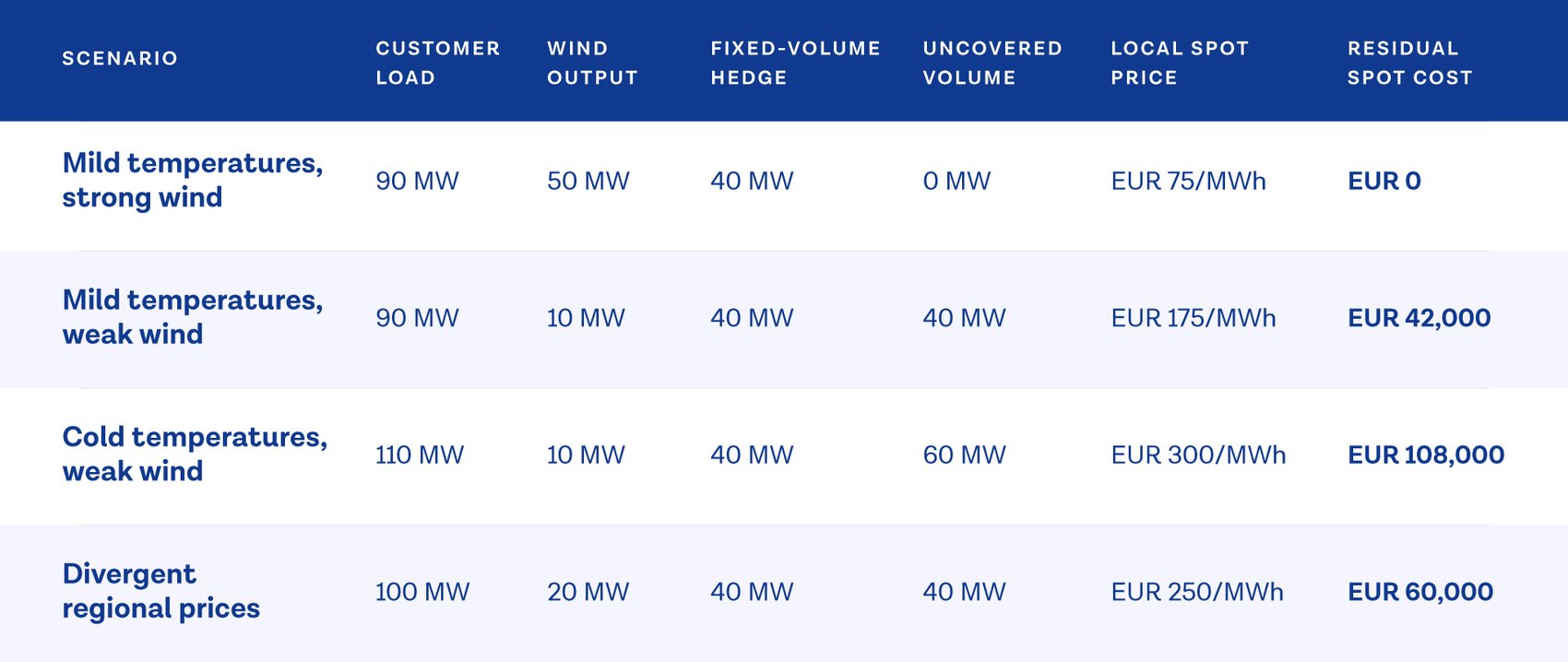
Hedging changes the exposure without necessarily removing it. A fixed-volume power hedge can protect against price movements while leaving the portfolio exposed to weather-driven changes in load. A hedge settled against a regional hub can leave basis risk if the physical position is located in another bidding zone. A renewable Power Purchase Agreement (PPA) can introduce shape risk when output falls during the hours in which power is most valuable.
The following illustration considers a fictional retailer across a six-hour winter evening period. It assumes a 40 megawatt (MW) fixed-volume hedge in every hour and a pay-as-produced wind contract. The residual spot cost excludes the cost or settlement value of the hedge and PPA.
What should winter scenario analysis measure?
A central forecast provides a useful planning baseline. Its limitation is that it represents one broad view of the season rather than the combinations capable of producing the most significant portfolio outcomes.
Scenario analysis can compare a defined set of conditions, such as mild temperatures with strong wind, mild temperatures with weak wind, or a cold and windless period affecting several connected markets.
Stochastic modeling extends the analysis further. Instead of assigning one value to load, renewable generation, fuel costs, and power prices, it simulates a range of possible paths while preserving the relationships between them. Those relationships matter because temperature, wind generation, gas prices, and regional power prices are neither independent nor perfectly correlated.
The resulting scenarios can then be applied to physical assets, procurement obligations, PPAs, and financial hedges. This allows market participants to examine the distribution of potential procurement costs, cash flows, gross margins, and hedge performance, rather than relying solely on an expected value.
The analysis also needs temporal and geographic detail. Hourly or sub-hourly modeling can reveal exposure concealed by daily or seasonal averages. Locational modeling can identify where transmission constraints, bidding-zone differences, or hub-based hedges create basis risk.
Is there such a thing as a low-risk winter?
A relatively mild winter could reduce aggregate heating demand and relieve pressure on parts of the European energy system. It cannot guarantee low wind exposure, available generation, unconstrained imports, or favorable gas prices in the hours that matter.
Winter risk therefore cannot be classified from a seasonal temperature forecast alone. It emerges from the interaction between weather, generation, fuels, transmission, and the portfolio’s physical and contractual position.
There may be such a thing as a low-risk winter for a particular portfolio. Identifying it requires understanding the range of conditions the portfolio could face, not simply the average weather Europe is expected to experience.
Identify the risk of a mild-winter